
-
Study in India +91 94270 77337
-
Study Abroad+91 91739 13939
-
E-mail us info@dishaconsultancy.org
 By Admin |
  July 02, 2026
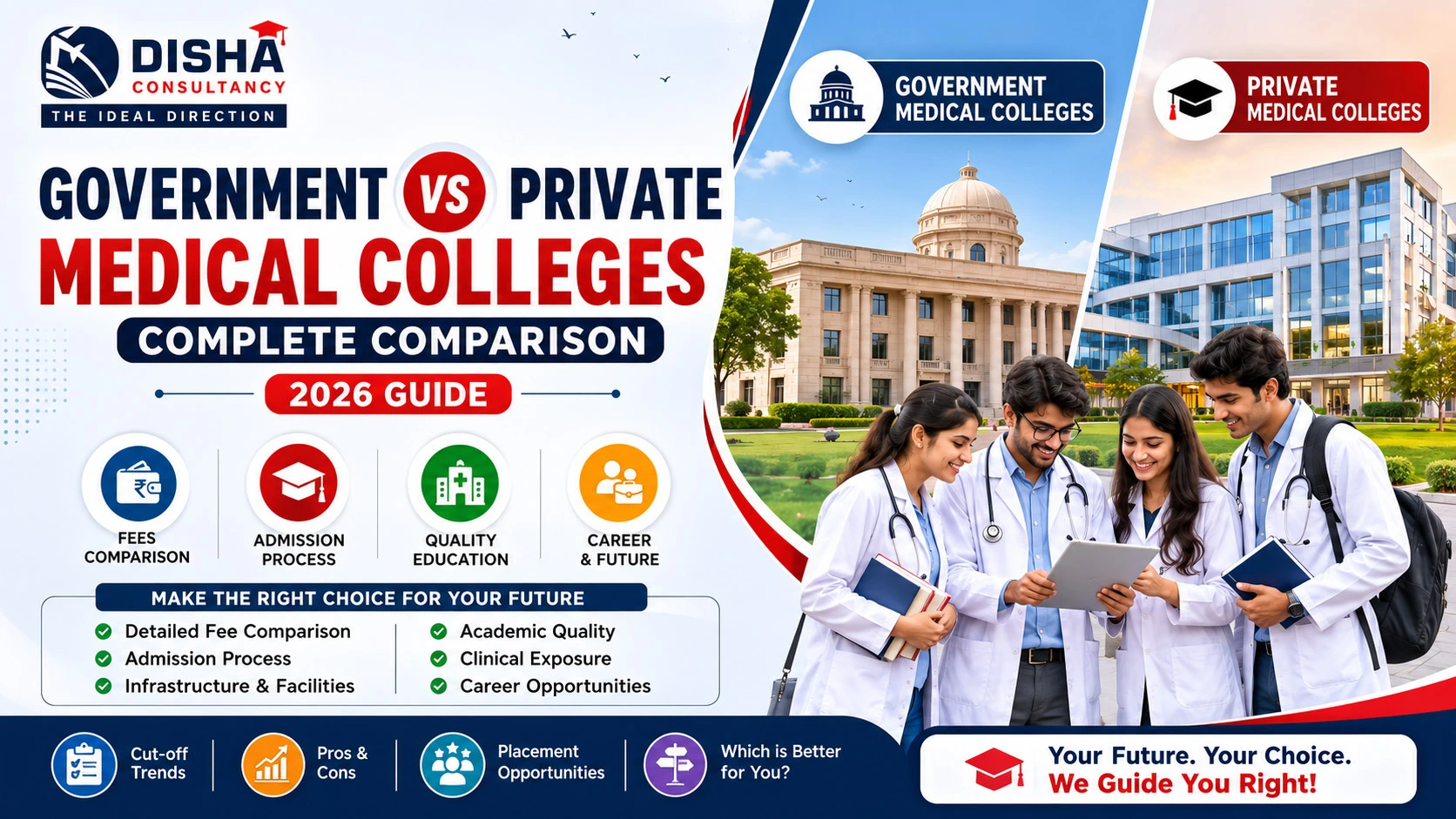
It is very competitive to get a seat in a postgraduate medical course (MD/MS) in Rajasthan. The decision between Government Medical College (GMC) and Private Medical College goes beyond financial considerations; it also impacts your clinical experience, hands-on time, and future practice path.
The major differences in the two types of structure are as follows:
| Factor | Government Medical Colleges (GMC / RajMES) | Private Medical Colleges |
|---|---|---|
| Fees (Clinical Branches) | ₹50,000 to ₹1.25 Lakh/year (RajMES Mgmt: ~₹9.5 Lakh/year) | ₹25 Lakh to ₹75+ Lakh/year (Mgmt./NRI Quota can exceed ₹1–1.5 Crore) |
| Patient Footfall | Massive, diverse, and relentless | Moderate to high; concentrated in specific demographics |
| Hands-On Exposure | Exceptionally high; residents handle primary procedures early | Supervised; slower progression to independent major surgeries |
| Stipend (approx.) | ₹55,000 to ₹65,000/month | Variable (often lower, delayed, or lower than state norms) |
| Service Bond | Mandatory state service bond (or penalty up to ₹25–50 Lakh) | No state service bond required |
The financial divide is steep. If you secure a seat in a premier government college like SMS Jaipur or SNMC Jodhpur, your academic fees are practically nominal.
Government Standard: Pure government seats cost less than ₹1 Lakh annually. But, semi-government Rajasthan RajMES (Medical Education Society) colleges have Management Quota seats which can go up to approximately ₹9.5 Lakh per year.
The Private Standard Fee Regime: Recent standardization means that the baseline of normal state clinical seats in private institutes (such as Mahatma Gandhi, JNU, Geetanjali, etc.) is around ₹25 Lakh to ₹35 Lakh per year.
Management & NRI Escalation: If you fall into the Private Management or NRI quotas for premium clinical branches (Radiology / Dermatology / General Medicine), then the annual fee is often in excess of ₹70 Lakh to ₹1.2 Crores.
Where you train shapes how comfortably you handle complications later.
Government Medical Colleges
Private Medical Colleges
Admissions for both types are centralized through the Office of the Chairman, NEET PG Medical Admission Board, Jaipur (RUHS).
The seat matrix is split cleanly into a 50% All India Quota (AIQ managed by MCC) and a 50% State Quota. When filling your choices, keep the State Eligibility Rules in mind: 50% of the institutional seats in private colleges favour candidates who completed their MBBS within Rajasthan.
If you are an out-of-state candidate, your primary window opens during the later counselling rounds (Round 3 and Stray Vacancy), where state eligibility limitations ease for vacant private seats.
1. Which is better for MD/MS in Rajasthan: Government or Private Medical Colleges?
Generally, government medical colleges are preferred as they have more patient visits, a regulated stipend structure, more clinical exposure and affordable fee rates. Private medical colleges, however, have advanced medical equipment, modern infrastructure, and may also be a good choice for candidates who could not get a seat in a government medical college and want to go for their desired specialization.
2. What is the fee difference between Government and Private MD/MS colleges in Rajasthan?
The tuition fees at government MD/MS colleges of Rajasthan are usually between Rs. 50,000/year and Rs. 1.25 lakh/year for the state quota seats. Private Medical colleges, on the other hand, have a tuition fee ranging from ₹25 lakh to ₹75 lakh or even higher, depending on the specialization and the number of seats available. Management and NRI quota fees can be significantly higher for highly sought-after clinical branches.
3. Do Government MD/MS colleges in Rajasthan have a compulsory service bond?
Yes. To get admission in most Government MD/MS colleges in Rajasthan, the students have to undergo a state service bond after completion of the post-graduation course. In case a candidate does not meet the conditions of the bond, then he may have to pay a significant amount of money as per the rules of the government. Typically, private medical colleges will not require a state service bond, which means that upon graduating from their course, the graduate will be able to enter into private practice or they can go further in their profession.
Choosing between a government and a private medical college for your MD/MS in Rajasthan is one of the most consequential decisions of your medical career. Government colleges offer unmatched clinical exposure and financial feasibility, while private colleges provide modern infrastructure and flexibility post-graduation. Aligning this decision with your specialization goals, financial capacity, and long-term career vision is essential. The expert counselling team at Disha Consultancy is here to help you navigate every step of the NEET PG and RUHS counselling process. Contact us today for a personalized strategy session.
Want to know more about Admissions or Counseling? Contact us now